The Stolarsky Array
Casey Mongoven
July 14, 2005
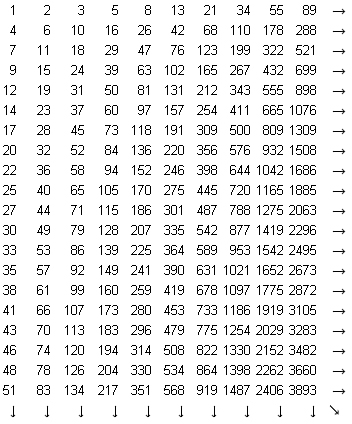
the array: Each row in the Stolarsky array is a
Fibonacci-type sequence. Each positive integer occurs once. The first number in
each row Z is the lowest positive
integer that has not occurred in any row above. The number following Z in that same row is given by round(Ф(Z)) where Ф = (1 + √5)/2.
general description of work: This work allows the listener to hear a part of the Stolarsky array
played out in physical space. It is written for a Fibonacci number of players x not less than 8 (i.e. 8, 13, 21, 34,
55, 89, …). The players are arranged in space according to the Stolarsky array.
Each player plays his note only once. After receiving numbers and being
assigned positions, the players play through the integers 1 through x. The composite rhythm of the work is
comparable to straight sixteenth notes.
Many aspects of the work
are left to the performers to determine. There are three possible versions of
this work; one for pitched instruments, one for instruments of indefinite pitch,
and one for percussion instruments of definite pitch.
instrumentation: a Fibonacci number of
instruments of indefinite pitch of the same type; each player plays one
instrument; at least 8 instruments must be used OR a Fibonacci number of instruments of definite pitch of
the same type which can be tuned to a high degree of accuracy; each player
plays one instrument; at least 8 instruments must be used OR a Fibonacci number of percussion instruments of definite
pitch of the same type and tuning; each player plays one instrument; at least 8
instruments must be used
INSTRUCTIONS FOR
INSTRUMENTS OF INDEFINITE PITCH:
1. A Fibonacci number of
players greater than 5 is chosen. We will call this number x.
example: 34
2. Instruments are chosen;
each player plays the same kind of instrument. Any instrument of indefinite
pitch is acceptable.
example: clapping
3. Each player is assigned
a number: 1 through x.
example: 1 through 34
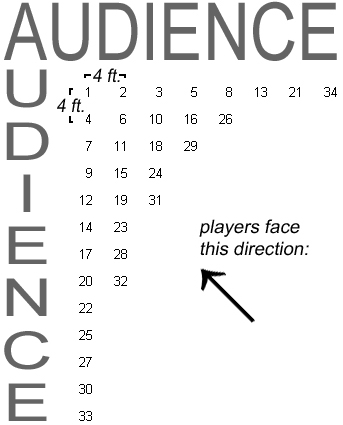
4. The players are assigned
positions according to the Stolarsky array. The rows and columns should be
spaced equally. A space of at least 4 feet should separate each player. Each
player should face the same "north-west" direction and hold his instrument in
an identical manner as the others. The audience is to be placed as in the
following example:
5. A tempo is chosen which
will not change during the performance. Some electronic device must be used for
synchronization. Some manner of articulation is determined. A dynamic level is
agreed upon; each player will play his note exactly as loud as the others and
in the same manner.
example: .5 seconds per
beat, conductor with metronome, fortissimo
6. The players play in
order 1 through x with exactly equal
space between each note.
INSTRUCTIONS FOR PERCUSSION
INSTRUMENTS OF DEFINITE PITCH:
1. A Fibonacci number of
players greater than 5 is chosen. We will call this number x.
example: 21
2. Instruments are chosen;
each player plays the same kind of instrument. The instruments must be of the
same pitch.
example: hand-bells, E-flat
(622.253 Hz)
3. Each player is assigned
a number: 1 through x.
example: 1 through 21
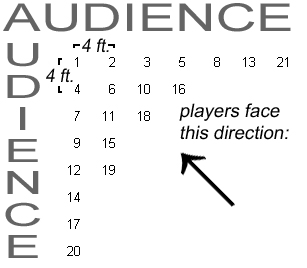
4. The players are assigned
positions according to the Stolarsky array. The rows and columns should be
spaced equally. A space of at least 4 feet should separate each player. Each
player should face the same direction and hold his instrument in the same
manner as the others. The audience should be placed as in the following
example:
5. A tempo is chosen which
will not change during the work. Some electronic device must be used for
synchronization. Some manner of articulation is determined. A dynamic level is
agreed upon; each player plays his note exactly as loud as the others and in
the same manner.
example: .05 seconds per
beat, conductor with metronome, tenuto, piano
6. The players play in
order 1 through x with exactly equal
space between each note.
INSTRUCTIONS FOR
INSTRUMENTS OF INDEFINITE PITCH:
1. A Fibonacci number of
players greater than 5 is chosen. We will call this number x.
example: 34
2. Instruments are chosen;
each player plays the same kind of instrument. Any instrument of indefinite
pitch is acceptable.
example: clapping
3. Each player is assigned
a number: 1 through x.
example: 1 through 34
4. The players are assigned
positions according to the Stolarsky array. The rows and columns should be
spaced equally. A space of at least 4 feet should separate each player. Each
player should face the same "north-west" direction and hold his instrument in
an identical manner as the others. The audience is to be placed as in the
following example:
5. A tempo is chosen which
will not change during the performance. Some electronic device must be used for
synchronization. Some manner of articulation is determined. A dynamic level is
agreed upon; each player will play his note exactly as loud as the others and
in the same manner.
example: .5 seconds per
beat, conductor with metronome, fortissimo
6. The players play in
order 1 through x with exactly equal
space between each note.
notes:
1. The placement of the
audience should not extend beyond the bounds of the performers, as shown in the
diagrams. There is no maximum number of people required in the audience, nor is
there any audience required.
2. Instruments of
indefinite pitch that are not acceptable are numerous: flutes, clarinets, horns,
oboes, bassoons, and wind instruments in general as well as brass instruments.
This list could go on much further. The instruments must be able to be intoned
with great accuracy.
3. If stringed instruments
are used, it is preferable that the players play their notes on the same
string. Open strings are preferable, but a capo similar to those used on a
guitar can be used to play in lower temperaments (temperaments with larger
intervals) as long as no open strings are used. The idea is that the timbre
stays similar, or morphs smoothly to a different one as the pitch falls or
rises.
4. Electronic performances
of this work are acceptable.
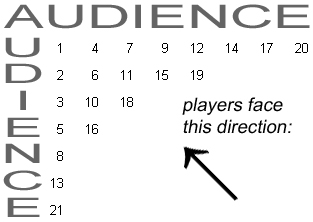
5. It is acceptable to
invert rows and columns as in the following example (so that the Fibonacci
sequence is the first column instead of the first row):
6. The examples given here
should not influence the players in any way in making choices that the
instructions theoretically allow.