The Wythoff Array
Casey Mongoven
July 13, 2005
the array: Each row in the Wythoff array is a Fibonacci
sequence. Each positive integer occurs once. The array can be created by taking
the non-negative integers Z and the
spectrum sequence floor(Ф(Z + 1)) based on the golden ratio Ф = (1 + √5)/2, and creating Fibonacci sequences
with them as follows:
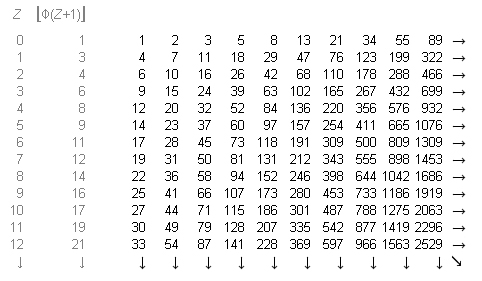
The section in black is the
Wythoff array.
general description of work: This work allows the listener to hear a part of the Wythoff array played
out in physical space. It is written for a Fibonacci number of players x not less than 8 (i.e. 8, 13, 21, 34,
55, 89, …). The players are arranged in space according to the Wythoff array.
Each player plays his note only once. After receiving numbers and being assigned
positions, the players play through the integers 1 through x. The composite rhythm of the work is comparable to straight
sixteenth notes.
Many aspects of the work
are left to the performers to determine. There are two possible versions of
this work, one for pitched instruments and one for instruments of indefinite
pitch.
instrumentation: a Fibonacci number of
instruments of indefinite pitch of the same type; each player plays one
instrument; at least 8 instruments must be used OR a Fibonacci number of instruments of definite pitch of
the same type which can be tuned to a high degree of accuracy; each player
plays one instrument; at least 8 instruments must be used
dedication: This work is dedicated to
the victims of the terrorist attacks in
INSTRUCTIONS FOR
INSTRUMENTS OF INDEFINITE PITCH:
1. A Fibonacci number of
players greater than 5 is chosen. We will call this number x.
example: 21
2. Instruments are chosen;
each player plays the same kind of instrument. Any instrument of indefinite
pitch is acceptable.
example: claves
3. Each player is assigned
a number: 1 through x.
example: 1 through 21
4. The players are assigned
positions according to the Wythoff array. The rows and columns should be spaced
equally. A space of at least 3 feet should separate each player. Each player
should face the same direction and hold his instrument in an identical manner
as the others. The audience is to be placed as in the following example:
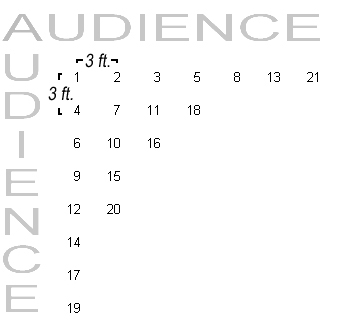
5. A tempo is chosen which
will not change during the performance. Some electronic device must be used for
synchronization. Some manner of articulation is determined. A dynamic level is
agreed upon; each player will play his note exactly as loud as the others and
in the same manner.
example: 1 second per beat,
conductor with metronome, triple fortissimo
6. The players play in
order 1 through x with exactly equal
space between each note.
INSTRUCTIONS FOR INSTRUMENTS
OF DEFINITE PITCH:
1. A Fibonacci number of
players greater than 5 is chosen. We will call this number x.
example: 34
2. Instruments are chosen;
each player plays the same kind of instrument. The instruments must be able to
be tuned with great accuracy.
example: cellos
3. A pitch orientation is
chosen; ascending or descending. Ascending means that the pitch rises in the
course of the piece, descending that the pitch falls.
example: ascending
4. Each player is assigned
a number: 1 through x.
example: 1 through 34
5. A temperament for tuning
the instruments and a base pitch is chosen. This temperament must be of the
form φz + 1, where z is a positive integer and φ = (-1
+ √5)/2. The instruments are tuned 1 through x according to the temperament and orientation chosen starting with
the base pitch. If an ascending orientation is chosen, 1 will be the lowest
pitch.
example: φ11 + 1, player 1 = 210 Hz
player 1 210.0000000000 Hz
player 2 210.6521802032 Hz
player 3 211.3063858303 Hz
player 4 211.9626231714 Hz
player 5 212.6208985364 Hz
player 6 213.2812182545 Hz
player 7 213.9435886748 Hz
player 8 214.6080161659 Hz
player 9 215.2745071163 Hz
player 10 215.9430679344 Hz
player 11 216.6137050483 Hz
player 12 217.2864249062 Hz
player 13 217.9612339764 Hz
player 14 218.6381387472 Hz
player 15 219.3171457270 Hz
player 16 219.9982614444 Hz
player 17 220.6814924484 Hz
player 18 221.3668453083 Hz
player 19 222.0543266138 Hz
player 20 222.7439429750 Hz
player 21 223.4357010226 Hz
player 22 224.1296074078 Hz
player 23 224.8256688025 Hz
player 24 225.5238918995 Hz
player 25 226.2242834120 Hz
player 26 226.9268500745 Hz
player 27 227.6315986421 Hz
player 28 228.3385358909 Hz
player 29 229.0476686182 Hz
player 30 229.7590036423 Hz
player 31 230.4725478026 Hz
player 32 231.1883079600 Hz
player 33 231.9062909965 Hz
player 34 232.6265038155 Hz
6. The players are assigned
positions according to the Wythoff array. The rows and columns should be spaced
equally. A space of at least 3 feet should separate each player. Each player
should face the same direction and hold his instrument in the same manner as
the others. The audience should be placed as in the following example:
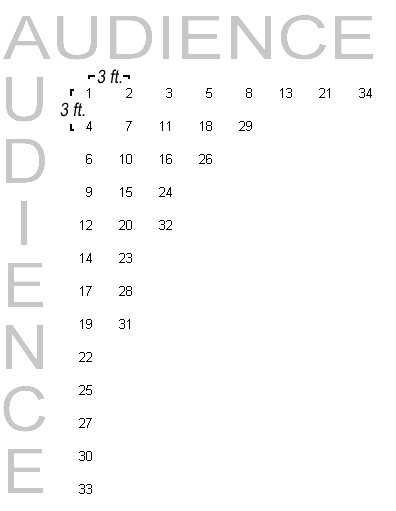
7. A tempo is chosen which
will not change during the work. Some electronic device must be used for
synchronization. Some manner of articulation is determined. A dynamic level is
agreed upon; each player plays his note exactly as loud as the others and in
the same manner.
example: 1 second per beat,
conductor with metronome, marcato pizzicato, triple fortissimo (ffff)
8. The players play in
order 1 through x with exactly equal
space between each note.
notes:
1. The placement of the
audience should ideally not extend beyond the bounds of the performers, as
shown in the diagrams. There is no maximum number of people required in the
audience, nor is there any audience required.
2. Instruments of
indefinite pitch that are not acceptable are numerous: flutes, clarinets,
horns, oboes, bassoons, and wind instruments in general as well as brass
instruments. This list could go on much further. The instruments must be able
to be intoned with great accuracy.
3. If stringed instruments
are used, it is preferable that the players play their notes on the same
string. Open strings are preferable, but a capo similar to those used on a
guitar can be used to play in lower temperaments (temperaments with larger
intervals) as long as no open strings are used. The idea is that the timbre
stays similar, or morphs smoothly to a different one as the pitch falls or
rises.
4. Electronic performances
of this work are acceptable.
5. The examples given here
should not influence the players in any way in making choices that the
instructions theoretically allow.