Collection X
Minimum Fibonacci Representation Filter no. 1
Casey Mongoven
December 8, 2009
Parameters

Collection XMinimum Fibonacci Representation Filter no. 1Casey MongovenDecember 8, 2009 |
|
|
Parameters
|
|
| |
| classification of work:audio synthesis engine:MATLAB show Csound orchestra synthesis technique:multi-tap delay-based Fibonacci representation filter This work is an implementation of a multi-tap delay-based filter which has its origins in the so-called miminum Fibonacci representations. A miminum Fibonacci representation is a number written as a sum of non-adjacent integers in a Fibonacci-type sequence. For the Fibonacci and non-truncated Lucas sequence, if N is a positive integer, there exist k positive integers where ci+1 > ci + 1 such that  where Fn is the nth integer in that Fibonacci-type sequence. For all other Fibonacci-type sequences (including the truncated Lucas seqeunce 1,3,4,7,11,...), certain N have no possible representation. Nonetheless, the property holds that ci+1 > ci + 1 for those values N with representations. Example: We may also use sequences like 1,4,5,9,14,..., and 2 cannot be represented here, but 6 can as 5 + 1. A greedy algorithm is used in generation; here, the "minimal" representation is created by always taking the largest possible value first. Any Fibonacci-type sequence with relatively prime positive integer starting values may be used as a basis for the minimal representations in this work. If no representation of n is possible, by definition the output of the filter is y[n] = 0; for those values of the equation which have representations one implements the FIR filter described by 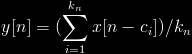 . Anything can be used for filtering (white noise, other music, speech, etc.). One always begins with the representation of 1. More than one sequence can be taken at a time as a basis; in this case, however, each sequence must be played synchronized on a separate channel and use the same source x[n]. The speakers should either be in an arc or in a circle; they must be evenly spaced, lie an equal distance from the listener and the closest speaker should be at least 1 meter away. The channels are placed according to their order; the lowest channel 1 can be either on the left or right side.. For renderings of this work in one channel, the number of samples used must be an integer occurring in the Fibonacci-type sequence used for the minimal representations. Two possibilities exist for simultaneously using more than one sequence: 1) One uses exclusively sequences where where F0 < F1 (i.e. 1,2,3,5,8,... or 2,5,7,12,19,..., and not 2,1,3,4,7,... or 1,1,2,3,5,...), and the sequences are played in canon (due to a mathematical property of such sequences making them all equal if one removes all non-representable numbers). One chooses an input size n corresponding to the nth integer of the "greatest" sequence used - that sequence whose summed values are the greatest. The sequences are assigned to channels from greatest sequence to least sequence (the Fibonacci sequence, for example, is always the least possible sequence and should therefore be the first or last channel if used). For each Fibonacci-type sequence used, one takes the nth number in that sequence as the final representation after which that channel stops playing; i.e. the lower sequences stop before those with greater values. Example: If I use {1,2,3,5,8,...}, {1,3,4,7,11,...} and {1,4,5,9,14,...}, I could choose to have input size 14, the 5th integer in the greatest sequence; the first sequence would then play on channel 1 for 8 samples, since the 5th integer is 8 (8 representations), the second with 11 samples (8 representations, since 2, 6 and 9 cannot be represented) on channel 2, the third plays all 14 samples (also 8 representations) on channel 3. The musical result is a micro-sonic canon. 2) Any sequence may be used. A number of samples is chosen as input based on an integer occurring in one of the sequences used. The sequences are arranged in channels from least to greatest (see possibility 1); all sequences play the same number of samples as the input, and they all stop at the same time. Example: If I use {1,1,2,3,5,8,13,...}, {2,1,3,7,11,18,29,...} and {3,1,4,5,9,14,23,...}, I could choose to have input size 13, since 13 occurs in the first sequence. All sequences would then play 13 samples. The resulting piece length should be the same length same as the input. The sample rate can be freely chosen; sample rates in audio-range are encouraged. global static parameters:sequence offset:1 number of audio channels:undefined loudness:undefined |
| global dynamic parameters: | |
|
