Collection X
Fibonacci Tilings no. 1
Casey Mongoven
July 9, 2010
Parameters

Collection XFibonacci Tilings no. 1Casey MongovenJuly 9, 2010 |
|
|
Parameters
|
|
| |
| classification of work:for acoustic instruments synthesis engine:F(n) instrumentalists show Csound orchestra Let Fn be the nth Fibonacci number; let F0 = 1 and F1 = 1. It is well known that the number of possible one dimensional tilings of length n using tiles of length 2 and 1 is given by Fn: 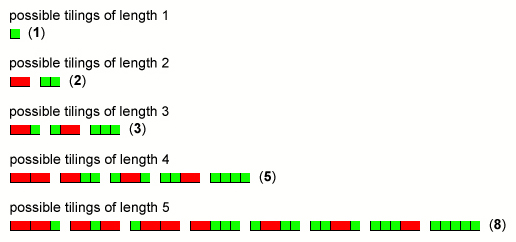 This piece is a sonification of such tilings. Two versions exist of this work: one for unpitched instruments and one for pitched instruments. The common features of both versions will be discussed first. 1.1 Rhythmic Structure The rhythmic structure of both versions is identical. The following steps should be followed: 1. Choose a Fibonacci number Fn of instrumentalists - players p(1), p(2), p(3), …, p(Fn) 2. Generate all tilings as described above up to length n (all tilings for lengths 1,2,3, …,n). 3. Rhythmically, each tile of length 2 gets 2 pulses, those of length 1 get 1 pulse. For example, we choose F4 = 5 instrumentalists, and so we generate the tilings up to length 4. We could notate these tilings as such: 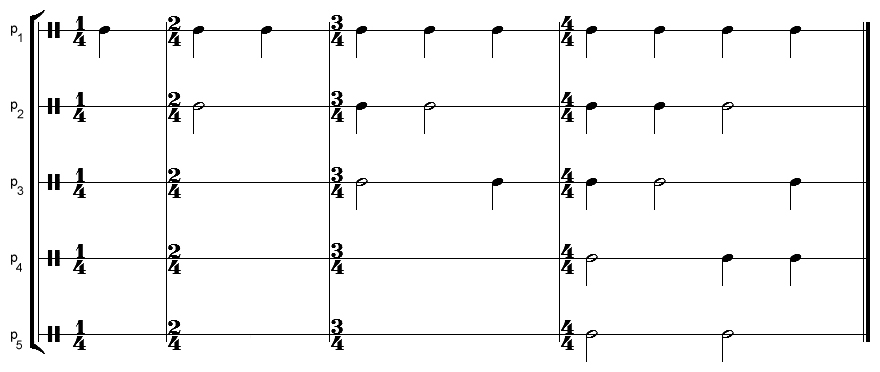 1.2 Simultaneous Sonification, Concatenation All tilings of a given length m are heard simultaneously; these tilings are concatenated (heard successively) for lengths 1, 2, 3, …, n - i.e. played in increasing length - as seen in the example above. 1.3. Who Plays What Players p(1) through p(Fm) play tilings of length m; p(1) plays the first representation alone, p(1) and p(2) play the tilings of length 2 etc. It does not matter who plays which tiling, so it would also be perfectly acceptable to play the above example as such: 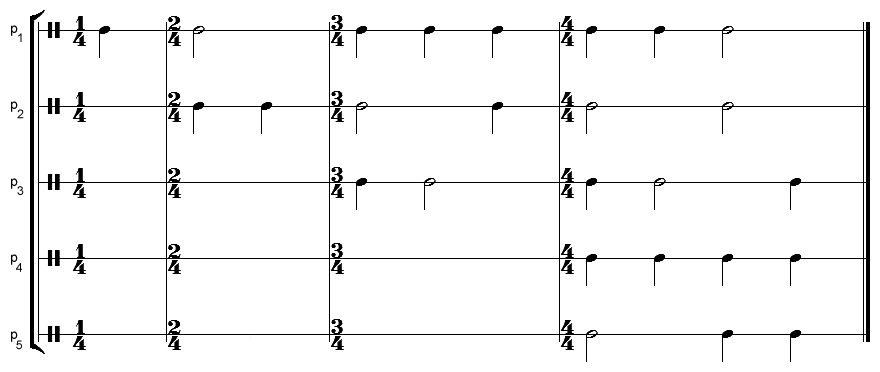 These decisions must be agreed upon prior to performance. 1.4 Spatial Arrangement of Performers The performers should be equidistantly spaced (measured from the center of the body) in a straight line in increasing order from p(1) to p(Fn). p(1) could be on the right or left; it does not matter. The performers should all face the same direction (i.e. do not face inward in terms of posture if using a conductor). The positions should be marked on stage. 1.5 Tempo The tempo can be freely chosen but it must stay perfectly steady throughout; the performers must use some form of metronome. It could be a conductor with a click track or metronome, or each performer could be provided with click tracks or some visual cues. 1.6 Dynamics Two options exist for dynamics: 1) all notes are attributed an equal dynamic level or 2) all tiles of length 2 are attributed one dynamic level, and those of length 1 a different one (e.g. all the quarter notes above are played forte and all half notes piano). It is important that each 1 and each 2 sounds - to the extent possible - exactly the same each time it is heard. 2.1 Version for Unpitched Instruments In choosing instruments, two options exist: 1) all performers use identical instruments or 2) all performers use the same two instruments - one instrument for the tiles of length 1 and a different one for those of length 2. The articulation of the tiles of length 1 can differ from that of length 2, however, once decided upon the performers must always use the same articulation for 1 and the same for 2 throughout the performance. Similarly, all players must articulate 1 and 2 in the same fashion. It is permissible to have one player play two parts (i.e. p(1) and p(2) are played by a single person) in cases where manpower is lacking. In this case the instruments should be spaced on stage equidistantly and the performers should be situated in between them. 3.1 Version for Pitched Instruments For pitched instruments, the requirements are more stringent. All performers use identical instruments, and these instruments must be able to play with a high degree of accuracy in one of two types of tuning: 1) the series of harmonic partials 2) a tuning where the unit interval satisfies φt + 1, where φ = (sqrt(5)-1)/2 and t is a positive integer Stringed instruments, for example, could be used in both cases, for example. However, an instrument such as a clarinet could not be used. Each player is assigned a tone and plays the same tone throughout, according to requirements to be explained. The performers must agree on an articulation for the tiles of length 1 and an articulation for tiles of length 2. Although the articulations can differ (e.g. pizzicato for 1s and arco for 2s), each performer must articulate the 1s and the 2s in the same fashion as all the other performers. 3.2 Using the Series of Harmonic Partials as a Tuning When using the series of harmonic partials, p(n) plays the nth harmonic partial (i.e. p(1) plays the fundamental, p(2) plays the second harmonic partial, p(3) the third and so on). 3.3 Using Scales Satisfying φt + 1 A starting pitch w is chosen for p(1). Two options are available: descending and ascending orientation. For ascending orientation, p(2) plays w(φt + 1), p(3) plays w(φt + 1)2, p(4) w(φt + 1)3 and so on (i.e. p(n) plays w(φt + 1)n - 1). For descending orientation p(2) plays w/(φt + 1), p(3) plays w/(φt + 1)2, p(4) w/(φt + 1)3 and so on (i.e. p(n) plays w/(φt + 1)n - 1). global static parameters:sequence offset:1 number of audio channels:undefined |
| global dynamic parameters: | |
|
