The Rabbit Sequence
Casey Mongoven
I. About This Composition
This work is for two percussion players and two percussion instruments
of indefinite pitch with crisp attacks and a fast decay;1 each
player has one instrument, the instruments need not be of the same type.
Cymbals, triangles and other instruments with a long decay and less crisp
attacks are not to be used. The players should find a combination of
instruments or an instrument that they find works best and sounds best for
them.
The players should be situated in front of the audience a good distance
from each other; they should be far enough from each other to create a
significant spatial independence of each part. This spatial independence
should, however, not be over-exaggerated. The players should consider the
environment in which they are playing and adjust accordingly.
This work is based on a sequence known as the rabbit sequence (also
known as the golden string, golden chain or infinite Fibonacci word). This is
an infinite binary sequence that is related to the golden mean and the
Fibonacci numbers. The sequence is a fractal. There are many ways of generating
this sequence. For the purpose of performance, one way of generating this
sequence will be concentrated upon in order to aid the performers in accurate
execution. It is imperative that the performers understand the construction of
the sequence in order to perform the work accurately and with flexibility.
II. Construction Of The Sequence
We will use 1s and 0s to represent the sequence (i.e. 1 0 1 1 0 1 0 1
...); the 1s represent player one's part and the 0s player two's. From a
performance standpoint, the best way to look at the construction of the
sequence is as follows:
We start with a 1, this is called stage 0 (the initiator):
1
From here forth we replace each 1 in the sequence with 1 0, so that the
next stage (stage 1) of the sequence is:
1 0
Now we have 1 0, a binary sequence. Moving on from here we replace each
1 with 1 0 as we did before, but now we replace each 0 in the sequence with 1
as well, so that the next stage of the sequence (called stage 2) is:
1 0 1
So far we started with 1, replaced that with 1 0, and then replaced 1 0
with 1 0 1. For each 1 we put 1 0 in its place, for each 0 we put a 1. Going
onto stage 3 we get:
1 0 1 1 0
Moving further to stage 4 we get:
1 0 1 1 0 1 0 1
Here is a good visual representation of this way of constructing the
sequence:
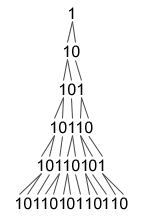
This shows the sequence up to stage 5, but the sequence can, of course,
go on endlessly.
III. Performers' Task
The composite rhythm of the work is straight. By this is meant that the
two voices combined create a constant rhythm comparable to straight sixteenth
notes. Here is an example of the work at stage 5 in traditional notation
– the sequence is written above the notes here to clearly show its
relation to the music:2
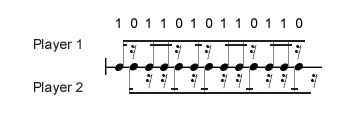
It can be seen that player one plays the 1s in the sequence, while
player two plays the 0s.
The tempo of the work is left up to the performers; it should, however,
be at least 155 attacks per minute. The length of the composition is also left
up to the performer – the composition will always contain a Fibonacci
number of attacks; the performers can choose what stage of the sequence they
want to perform and should indicate this to the audience (i.e. the title of the
work in the program might read something like The Rabbit Sequence, Stage 7).3
The dynamic level should stay perfectly steady throughout and should be from mezzoforte
to double-fortissimo (mf – fff). Both parts
should be played at the same dynamic level.
If more than one stage is being performed on the same concert, then the
different stages should be performed at the same tempo and with the same
instruments. If the stages are to be performed consecutively, long pauses (at
least 20 seconds) should be given in between the stages.
This work is to be performed with a metronome or click-track. Each
performer should have an earphone in the ear opposite the other performer. The
metronome will help the large-scale accuracy of the performance; it does not
make the execution of this work easier for the performers.
Each attack is to be thought of by the performers as exactly as long as
1 unit. It is not suppose to be thought of as a point, rather as a line. For
instruments with decay times longer than each unit, where the sound is still
decaying when the next attack occurs, the players should mute their instruments
every time they have a rest.
IV. Exercises And Methods For The Performers
The following is an explanation of the methods and exercises I would
like the performers to use in performing this work. Mastery of these methods
will take hard work. Once these techniques are mastered, the performers will be
able to perform this work with great ease and flexibility. Because of the
somewhat complicated nature of these methods, I have relied heavily on
traditional notation.
Here is a simple exercise that is fundamental in performing this composition:
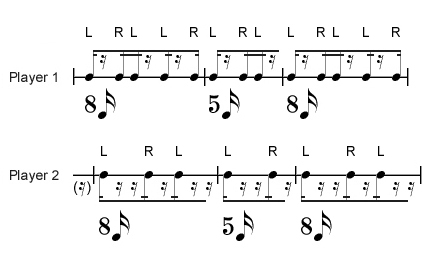
Notice the rest in parenthesis at the beginning for player two. Although
player two's part does in reality start with a rest, the player will find it
easier not to think about it this way; player two should try to imagine his
first note as the first note in the composition. Later, if the performers were
to switch parts, the players would find it very easy if the composition is
thought of in this way.
Note the stroke-patterns (L R L L R L R L ...); for some instruments this
won't apply. The players should practice their parts both together and
independently at various tempos.4 This
exercise is crucial to performing this work, and needs to be completely
internalized before moving on.
Before it was mentioned that player one plays the 1s and player two the
0s in the sequence. The performers shouldn't allow this to confuse them in the
discussion that follows. That view of the sequence and its relation to the work
is best left aside for now. Each player will now use the sequence in its full
form to aid them in performance – they will use both 1s and 0s.
The next step involves substituting the numbers in the rabbit sequence
with "measures." Basically, player one will think of the 1s and 0s in the
rabbit sequence as such:
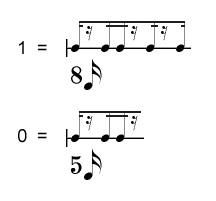
So using player one's part as an example:
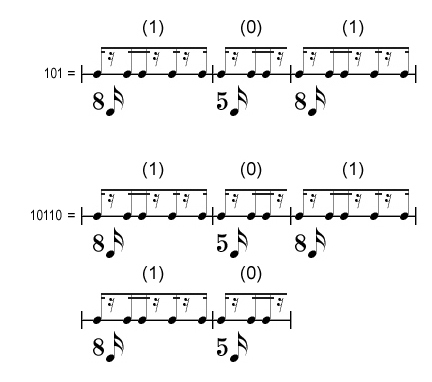
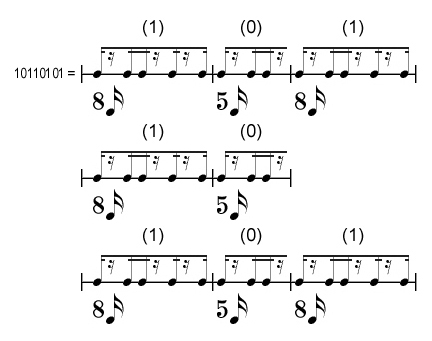
and so on, depending on the desired length of
the composition.
Player two will think about the sequence as such:
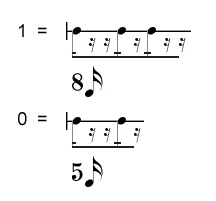
therefore:
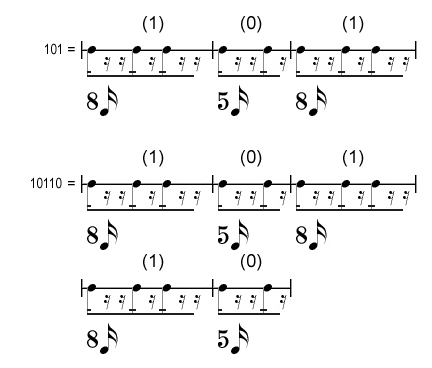
and so on...
Once the performers have gotten used to doing this, they should be able
to play the work with just a sheet of numbers in front of them to guide them.
Performers who have internalized the structure of the sequence to a higher
degree might not even need this; they might indeed be able to visualize the
sequence in their minds. A performer may want to expand the 1 and 0 as to contain
more attacks. These numbers will always be adjacent Fibonacci numbers, with the
1 being the greater of the two. For example:
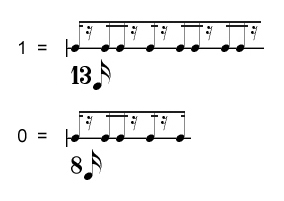
This will make longer performances and performances without a guide
sheet easier. It is not incredibly important how many attacks the 1 or 0 are
imagined as consisting of. This only serves as an aid to the performer. That is
up to the performers and all will have different preferences; two performers
playing this composition together might use different numbers from each other
in performance.5 Once this method of performing the composition is
understood, the performers will gain great flexibility and will be able to
perform the composition at various stages on command.
V. A Theoretical
Performance
Let us suppose that two players have decided to play the composition at
stage 9 with 390 attacks per minute on wood blocks at the dynamic level forte.
After they have practiced the exercises given above and internalized the
structure of the sequence, they decide to make a sheet of numbers to aid them
in performance. Player one decides he wants to think of the 1 in the sequence
as containing 5 attacks and the 0 as containing 3, player two chooses to do the
same, so:
Player 1:
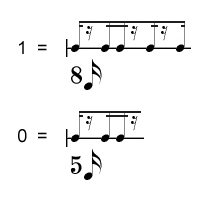
Player 2:
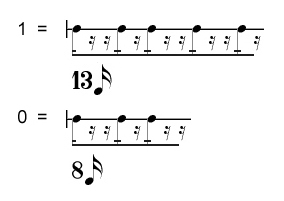
The performers internalize the patterns above. Since the performance is
89 attacks long at stage 9, the performers need to calculate how many numbers
of the rabbit sequence they will need to substitute with the "measures" above
to fit their total number of attacks. Player one plays 55 attacks, player two
plays 34 (these numbers will always be adjacent Fibonacci numbers, with player
one's being the higher number). Their sheet of numbers during performance looks
like this:
Player 1:
1 0 1 1 0 1 0 1 1 0 1 1 0
Player 2:
1 0 1 1 0 1 0 1
In performance they simply read through the sequence replacing the 1s
and 0s with the "measures" shown above, which they have practiced and
internalized.
VI. Composition Lengths And Corresponding Stages
Here are the first 21 stages and their lengths in attacks:
Length in Attacks Stage
1 0
2 1
3 2
5 3
8 4
13 5
21 6
34 7
55 8
89 9
144 10
233 11
377 12
610 13
987 14
1597 15
2584 16
4181 17
6765 18
10946 19
17711 20
Here is a table to give performers an idea of the duration of the
different stages at different tempos:6


